MiniDLNA and go2rtc are both open-source media-related technologies, but they are designed for very different workflows. MiniDLNA is a lightweight DLNA/UPnP media server used to share locally stored media across a network, while go2rtc is a real-time media streaming gateway designed to connect, process, and restream video and audio sources.
Their differences become particularly important when considering protocols, latency, hardware requirements, compatibility, and typical applications.
MiniDLNA vs go2rtc: Quick Comparison
| Feature | MiniDLNA | go2rtc |
| Primary purpose | Local media server | Real-time media streaming gateway |
| Main function | Shares stored media over a network | Connects and restreams live media sources |
| Typical content | Local video, audio, and images | Live camera and streaming sources |
| DLNA/UPnP | Core functionality | Not its primary purpose |
| Real-time streaming | Limited/not its primary focus | Core functionality |
| Protocol support | Primarily DLNA/UPnP | Multiple real-time and streaming protocols |
| User interface | Minimal server interface | Web/API-oriented configuration and interfaces |
| Latency focus | General media streaming | Low-latency real-time media |
| Hardware requirements | Generally low | Depends on sources, codecs, and processing |
| Typical environments | Home media servers and NAS | Cameras, automation, surveillance, and media gateways |
What Is MiniDLNA?
MiniDLNA is a lightweight media-server application based on DLNA and UPnP standards. It allows users to make locally stored videos, music, and photographs available to compatible devices connected to the same network.
The server generally does not provide the main playback interface. Instead, compatible televisions, media players, game consoles, and other client applications discover the server and access the available media.
Key Features of MiniDLNA
- DLNA/UPnP media sharing
- Local network streaming
- Support for video, audio, and image collections
- Lightweight resource usage
- Simple server configuration
- Suitable for NAS and home-server environments
- Access to personal media from multiple compatible clients
MiniDLNA Limitations
MiniDLNA is primarily designed for serving existing media files rather than handling live camera streams or acting as a real-time media gateway.
Potential limitations include:
- Not designed primarily for real-time camera streaming
- Limited protocol flexibility compared with a dedicated media gateway
- Playback generally depends on client devices
- Format compatibility can depend on receiving devices
- Limited processing and routing functionality
What Is go2rtc?
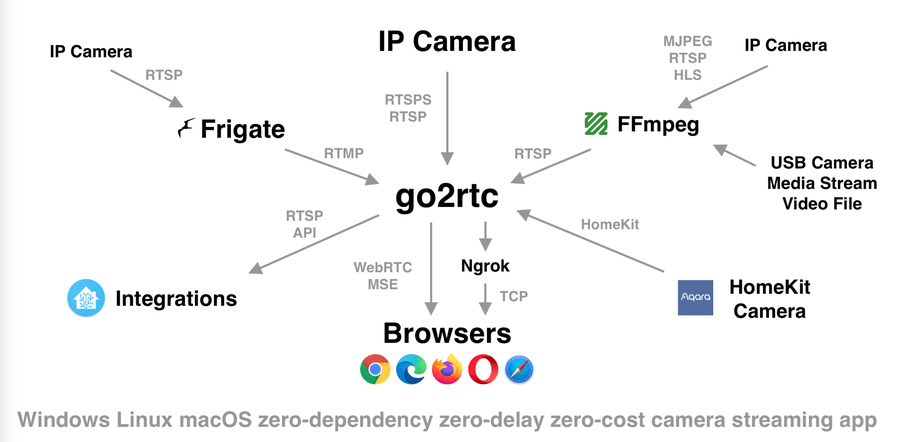
go2rtc is a real-time media streaming application designed to connect different video and audio sources and make them available through multiple streaming protocols.
It is commonly associated with IP cameras, security systems, home automation platforms, and other applications that need to move live audio and video between different protocols or clients.
Rather than functioning as a traditional personal media library, go2rtc focuses on live media streams and protocol conversion or restreaming.
Key Features of go2rtc
- Real-time video and audio streaming
- Support for multiple streaming protocols
- Restreaming between compatible protocols
- Camera and live-stream integration
- WebRTC support
- RTSP-related workflows
- API-oriented architecture
- Designed for low-latency streaming scenarios
- Integration potential with home-automation and surveillance systems
go2rtc Limitations
go2rtc is not intended to replace a conventional DLNA media server or personal media library.
Potential limitations include:
- More technically oriented configuration
- Not primarily designed for browsing local movie and music collections
- Resource requirements vary according to the media sources and processing
- Protocol and codec compatibility can require configuration
- Intended use cases may be more complex than basic home media sharing
MiniDLNA vs go2rtc: Performance
The two applications have different performance goals.
MiniDLNA is designed to serve existing media files over a local network. Its relatively lightweight architecture can make it suitable for modest hardware. Network bandwidth, storage performance, media bitrate, and the receiving device can influence playback.
go2rtc is designed for live media workflows where latency and stream handling are important. Performance can depend on the number of connected sources, number of clients, video resolution, codecs, protocol conversions, and whether media needs to be processed or transcoded.
For MiniDLNA, storage and local-network performance are generally important. For go2rtc, real-time processing, network conditions, source characteristics, and the number of simultaneous streams can have a greater impact.
Compatibility
MiniDLNA Compatibility
MiniDLNA is designed around DLNA and UPnP compatibility.
Potential clients include:
- Smart TVs
- Network media players
- Game consoles
- Mobile media applications
- Desktop media software
The client device ultimately determines which media formats it can play.
go2rtc Compatibility
go2rtc is designed to work with a variety of real-time media sources and protocols. Its compatibility depends on the protocols, codecs, and formats supported by the source and destination.
It can be used in environments involving:
- IP cameras
- Surveillance systems
- Home-automation platforms
- Web-based video clients
- Real-time media applications
- Other compatible streaming software
The exact capabilities depend on the go2rtc version and configured protocols.
Hardware and System Requirements
MiniDLNA is designed to be lightweight and can operate on relatively modest systems. Common environments include NAS devices, small home servers, older computers, and low-power systems.
go2rtc can also run efficiently in many environments, but its resource requirements depend more heavily on the number and complexity of live streams. High-resolution cameras, multiple clients, codec processing, and protocol conversion can increase CPU, memory, and network requirements.
A simple restreaming setup may require relatively modest resources, while more complex deployments can require more capable hardware.
Network Requirements
MiniDLNA primarily operates within a local network. When media files are stored locally, internet access is not inherently necessary for streaming them to compatible devices.
go2rtc is also commonly deployed on local networks, particularly with IP cameras and home-automation systems. However, its network requirements can be more demanding when multiple real-time streams are involved.
MiniDLNA Network Considerations
- Local Wi-Fi or Ethernet performance
- Server-to-client bandwidth
- Media bitrate
- Storage speed
- Number of connected clients
go2rtc Network Considerations
- Camera stream bitrate
- Number of simultaneous streams
- Client count
- Network latency
- Protocol overhead
- Upload and download bandwidth
- Stability of real-time connections
Media Management
MiniDLNA is centered on a personal media collection. Users configure directories containing videos, music, and photographs, and compatible devices can browse the available content.
go2rtc is focused on live media sources rather than traditional media-library management. It handles streams from sources such as cameras and makes them available to compatible clients or applications.
This creates an important distinction: MiniDLNA organizes access to stored media, while go2rtc manages live media streams and their delivery between compatible systems.
Ease of Setup
MiniDLNA generally involves installing the server, specifying media directories, and allowing compatible clients to access it through the local network.
go2rtc typically involves configuring streams, protocols, sources, and destinations. Basic configurations can be relatively simple, but more advanced deployments may require a stronger understanding of networking, codecs, and streaming protocols.
The setup complexity therefore depends heavily on the intended deployment.
Common Use Cases
MiniDLNA Use Cases
MiniDLNA can be used for:
- Sharing locally stored movies
- Streaming personal music collections
- Viewing photos on compatible televisions
- Creating a lightweight home media server
- Sharing media stored on a NAS
- Providing local media access to multiple DLNA-compatible devices
go2rtc Use Cases
go2rtc can be used for:
- Connecting IP cameras to other applications
- Restreaming live camera feeds
- Supporting low-latency video workflows
- Bridging different streaming protocols
- Integrating cameras with home-automation systems
- Providing real-time media streams to compatible clients
- Simplifying distribution of live video and audio sources
Pros and Limitations at a Glance
MiniDLNA
Pros
- Lightweight
- Low resource requirements
- DLNA/UPnP support
- Simple local media sharing
- Suitable for personal media libraries
- Compatible with many consumer media devices
Limitations
- Not designed primarily for live streaming
- Limited real-time media functionality
- Playback depends on compatible client devices
- Fewer protocol and stream-management features
go2rtc
Pros
- Designed for real-time media
- Supports multiple streaming protocols
- Useful for IP-camera workflows
- Suitable for low-latency applications
- Can restream live sources
- Useful for integration with other media and automation systems
Limitations
- More technically focused
- Not a traditional media-library server
- Configuration can become complex
- Resource requirements vary with stream processing
- Compatibility depends on protocols and codecs
MiniDLNA vs go2rtc: Feature Comparison by Use Case
| Requirement | MiniDLNA | go2rtc |
| Share local movies | ✓ | Not a primary function |
| Share local music | ✓ | Not a primary function |
| Share personal photos | ✓ | No |
| DLNA/UPnP media serving | ✓ | No |
| Stream IP-camera feeds | Not a primary function | ✓ |
| Real-time media streaming | Limited | ✓ |
| Low-latency video workflows | No | ✓ |
| Protocol bridging/restreaming | Limited | ✓ |
| Home media server | ✓ | Not a primary function |
| Camera and automation integration | Limited | ✓ |
Final Thoughts
MiniDLNA and go2rtc serve different areas of networked media. MiniDLNA focuses on sharing locally stored videos, music, and images through DLNA/UPnP, making it suitable for traditional home media-server environments.
go2rtc focuses on live video and audio streams, with an architecture designed for real-time media delivery, protocol compatibility, and integrations involving cameras and other streaming sources.