MediathekViewWeb vs Go2RTC compares two open-source media technologies that operate in very different areas of the streaming ecosystem. Although both are associated with online video, their purposes, architectures, and typical workflows are fundamentally different.
MediathekViewWeb is primarily a web-based platform for discovering and accessing television programs from German public-service media libraries. Go2RTC, by contrast, is a real-time media streaming application designed to receive, process, convert, and redistribute streams from cameras and other media sources.
Understanding the differences between these solutions requires looking beyond basic video playback. Their features, performance characteristics, compatibility, system requirements, and use cases address different technical problems.
MediathekViewWeb vs Go2RTC at a Glance
| Category | MediathekViewWeb | Go2RTC |
| Primary purpose | Search and access broadcaster media-library content | Real-time media streaming and stream redistribution |
| Application type | Web-based media discovery platform | Streaming server/service |
| Main content | Television programs and broadcaster media | Cameras, RTSP sources, webcams, and other streams |
| Primary environment | Web browser | Server, desktop, container, or embedded environment |
| Streaming focus | On-demand media playback | Real-time stream processing |
| Typical protocols | Web-based media delivery | RTSP, WebRTC, HLS, RTMP and other supported protocols |
| Search functionality | Strong | Not a primary function |
| Live camera streaming | Not its main purpose | Core use case |
| Media conversion | Limited/not central | Important capability |
| Best suited for | Discovering television content | Connecting and redistributing live media sources |
What Is MediathekViewWeb?
MediathekViewWeb is a browser-oriented interface designed to make it easier to search and access content available through German public-service broadcasters’ media libraries.
Instead of visiting individual broadcaster platforms separately, users can search through a centralized interface for programs such as documentaries, news, reports, educational content, and other television programming.
Its architecture is focused more on media discovery and on-demand viewing than on acting as a general-purpose streaming server.
Main Characteristics of MediathekViewWeb
- Browser-based operation
- Centralized program discovery
- Media-library search
- Filtering and sorting functionality
- Focus on German public-service broadcasters
- On-demand video access
- Broad browser compatibility
- Minimal local installation requirements
What Is Go2RTC?
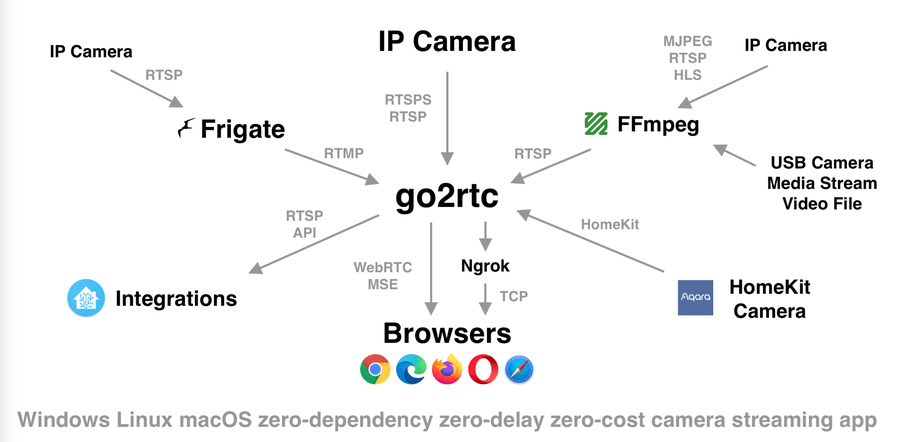
Go2RTC is a real-time media streaming application designed to connect media sources with different streaming clients and protocols.
It is especially relevant in surveillance, smart-home, camera, and real-time video environments. A source such as an IP camera can provide a stream through one protocol, while Go2RTC can make that media available through other supported mechanisms.
The software is therefore better understood as a media-streaming bridge and server component rather than a consumer-facing media-library search application.
Main Characteristics of Go2RTC
- Real-time media streaming
- Camera and IP-stream integration
- Protocol conversion and bridging
- WebRTC support
- RTSP support
- HLS-related streaming workflows
- Integration with home-automation and surveillance environments
- Lightweight server-oriented architecture
Core Difference Between MediathekViewWeb and Go2RTC
The most important difference is their purpose.
MediathekViewWeb helps users find and watch existing television content.
Go2RTC helps technical systems receive, process, and redistribute real-time media streams.
This distinction affects practically every part of the comparison.
MediathekViewWeb is designed around people searching for programs. Go2RTC is designed around applications, cameras, servers, and clients exchanging real-time media.
Therefore, they are not conventional substitutes for one another.
Architecture Comparison
MediathekViewWeb Architecture
MediathekViewWeb follows a web-service model.
Its workflow generally involves:
- Gathering or indexing relevant media-library information.
- Presenting searchable content through a web interface.
- Allowing users to filter and select programs.
- Connecting users to available media playback.
- Using browser-based technology for viewing.
This architecture prioritizes accessibility and content discovery.
Go2RTC Architecture
Go2RTC follows a streaming-service model.
A simplified workflow looks like:
- A camera or other source provides media.
- Go2RTC receives the stream.
- The service handles supported media protocols.
- It makes the stream available to compatible clients.
- Clients consume the stream through an appropriate protocol.
This architecture prioritizes low-latency delivery, protocol interoperability, and real-time media distribution.
Feature Comparison
MediathekViewWeb Features
MediathekViewWeb focuses on features that help users locate and consume television programming.
Key capabilities include:
- Program search
- Content filtering
- Media-library browsing
- Program metadata
- Browser-based playback
- Centralized content discovery
- Cross-device browser access
Its feature set is therefore primarily user-facing.
Go2RTC Features
Go2RTC is much more technically oriented.
Important capabilities can include:
- Real-time stream handling
- RTSP connectivity
- WebRTC delivery
- HLS-related workflows
- Camera integration
- Stream proxying
- Protocol bridging
- Low-latency media delivery
- Integration with other applications
- Multiple input and output streaming workflows
Its features are primarily concerned with how media moves between sources and clients.
Performance Comparison
Performance has different meanings in these two systems.
MediathekViewWeb Performance
For MediathekViewWeb, performance is mostly associated with:
- Search responsiveness
- Browser performance
- Page loading
- Media-source availability
- Video buffering
- Network bandwidth
- Playback resolution
The server infrastructure and underlying media providers also influence the overall viewing experience.
For ordinary program discovery, resource consumption on the user’s device is generally modest. Video playback can require significantly more bandwidth and hardware resources.
Go2RTC Performance
For Go2RTC, performance is strongly related to real-time media processing and network transport.
Important factors include:
- Number of simultaneous streams
- Video resolution
- Codec
- Bitrate
- Protocol
- CPU resources
- Network throughput
- Hardware acceleration
- Number of connected clients
Low-latency applications can place particular importance on efficient stream handling. A poorly configured source, insufficient bandwidth, or excessive transcoding can increase latency and resource consumption.
Compatibility
MediathekViewWeb Compatibility
MediathekViewWeb’s browser-based design gives it broad compatibility.
It can generally be accessed from devices running modern browsers, including:
- Windows
- Linux
- macOS
- Android
- iOS and iPadOS
- Other browser-capable platforms
The exact playback experience depends on browser support, media formats, and the availability of the underlying content.
Go2RTC Compatibility
Go2RTC is designed for technical environments rather than a particular consumer operating system.
Its compatibility can extend across environments such as:
- Linux
- Windows
- macOS
- Containers
- Home-server systems
- Embedded systems
- Smart-home environments
Compatibility also depends heavily on the protocols and codecs used by connected sources and clients.
Protocol Support
Protocol handling is a defining characteristic of Go2RTC.
It is designed to work with streaming technologies commonly found in real-time video environments. These can include:
- RTSP
- WebRTC
- HLS
- RTMP
- Other supported media transport mechanisms
The exact capabilities depend on the implementation and configuration.
MediathekViewWeb does not have the same protocol-bridging role. Its primary concern is presenting accessible media-library content through a web-based experience.
System Requirements
MediathekViewWeb Requirements
The basic user requirements are relatively light:
- Modern web browser
- Internet connection
- Compatible device
- Adequate bandwidth for video playback
Users generally do not need to maintain a dedicated streaming server simply to browse and watch supported media-library content.
Go2RTC Requirements
Go2RTC is generally deployed as a service, so requirements depend on the scale of the streaming workload.
Important considerations include:
- Supported operating environment
- CPU resources
- RAM
- Network bandwidth
- Storage where applicable
- Camera or media-source compatibility
- Required ports and network configuration
A small installation with one or two streams can have modest requirements, while multiple high-resolution streams and many clients can require significantly more resources.
Real-Time Streaming and Latency
Latency is particularly important when comparing Go2RTC with a media-library platform.
MediathekViewWeb is primarily concerned with on-demand playback. A small amount of startup buffering is generally acceptable because the content is not intended to function as a real-time camera feed.
Go2RTC, however, can be used for applications where low latency is important, such as:
- Security cameras
- Remote monitoring
- Smart-home dashboards
- Live camera views
- Real-time browser playback
Protocol selection and configuration can significantly affect latency.
Scalability
The two solutions scale in fundamentally different ways.
MediathekViewWeb’s scalability is primarily associated with handling users, searches, indexed media information, and access to available content.
Go2RTC’s scalability is more closely tied to:
- Number of input streams
- Number of output streams
- Number of clients
- Bitrate
- Resolution
- Protocol overhead
- Hardware resources
- Network capacity
For a streaming infrastructure, adding more simultaneous streams can create substantial CPU and bandwidth requirements depending on whether streams are passed through directly or require additional processing.
Security Considerations
Security requirements are also different.
MediathekViewWeb is primarily accessed as a public-facing web service. Users interact with the platform through standard browser-based communication.
Go2RTC may be deployed inside a private network or exposed to remote clients. This makes configuration security particularly important.
Administrators should consider:
- Network exposure
- Authentication mechanisms where applicable
- Firewall rules
- Secure remote access
- Camera credentials
- Stream-source permissions
- Encryption and secure transport
- Access control
Exposing camera streams or management interfaces directly to the public internet without appropriate protection can create unnecessary security risks.
Use Cases
MediathekViewWeb Use Cases
MediathekViewWeb is well suited to:
- Searching German public-broadcast programming
- Finding documentaries
- Discovering news programs
- Watching educational content
- Locating previously broadcast television programs
- Browsing media libraries
- Accessing content through different browser-capable devices
Go2RTC Use Cases
Go2RTC is better aligned with technical streaming scenarios such as:
- IP camera streaming
- Home surveillance
- Smart-home dashboards
- Web-based camera viewing
- RTSP-to-WebRTC workflows
- Real-time media redistribution
- Connecting incompatible streaming clients
- Integrating cameras with other applications
Pros and Limitations of MediathekViewWeb
Pros
- Centralized media discovery
- Simple browser-based access
- Broad platform compatibility
- Convenient search and filtering
- Strong focus on television media libraries
- Minimal local setup for ordinary users
- Useful for on-demand viewing
Limitations
- Primarily focused on supported broadcaster content
- Not designed as a general streaming server
- Limited relevance to IP-camera workflows
- Dependent on underlying media providers
- Browser and network conditions affect playback
Pros and Limitations of Go2RTC
Pros
- Designed for real-time media
- Strong protocol interoperability
- Useful for camera streams
- WebRTC support
- Suitable for self-hosted environments
- Can bridge different streaming workflows
- Useful for smart-home and surveillance integrations
- Can provide low-latency streaming depending on configuration
Limitations
- Requires technical configuration
- Primarily aimed at infrastructure rather than casual media consumption
- Performance depends on stream count and configuration
- Network configuration can become complex
- Security requires careful administration
- Not designed as a media-library search platform
Resource Efficiency
Resource usage should be evaluated according to workload.
MediathekViewWeb generally places most of the local workload on the browser and video decoder. The user’s device mainly needs to display the interface and decode the selected media.
Go2RTC can introduce server-side resource requirements because the system may receive and redistribute multiple live streams. Direct stream handling can be relatively efficient, while processing or transcoding workloads can increase CPU requirements.
This makes resource planning much more important in larger Go2RTC deployments.
Typical User Profiles
MediathekViewWeb is primarily aimed at media consumers who want an easier way to discover television programs.
Go2RTC is more relevant to developers, system administrators, home-automation users, surveillance enthusiasts, and self-hosting environments that need to connect live media sources with compatible clients.
Their audiences therefore overlap very little despite both dealing with video.
Key Differences to Consider
When evaluating MediathekViewWeb vs Go2RTC, the following distinctions are particularly important:
- Purpose: MediathekViewWeb focuses on media discovery, while Go2RTC focuses on real-time streaming infrastructure.
- Content: MediathekViewWeb works with television media-library content, while Go2RTC commonly handles camera and live-stream sources.
- Architecture: MediathekViewWeb is web-service oriented, while Go2RTC functions as a streaming service.
- Latency: Go2RTC is designed for real-time scenarios, while MediathekViewWeb primarily supports on-demand viewing.
- Protocols: Go2RTC provides extensive protocol-oriented streaming functionality.
- Installation: MediathekViewWeb generally requires a browser, whereas Go2RTC normally requires deployment and configuration.
- Technical complexity: MediathekViewWeb is oriented toward straightforward media discovery, while Go2RTC can require networking and streaming knowledge.
- Scalability: MediathekViewWeb deals primarily with user and content access, while Go2RTC must account for streams, clients, bandwidth, and processing resources.
Final Comparison
MediathekViewWeb vs Go2RTC is ultimately a comparison between media discovery and real-time streaming infrastructure.MediathekViewWeb provides a centralized browser-based way to discover and access German public-service television content, making its architecture primarily focused on search, program information, and on-demand playback.
Go2RTC serves a different technical purpose by connecting real-time media sources with streaming clients through protocols designed for live video delivery. Its capabilities are particularly relevant to cameras, self-hosted streaming systems, smart-home environments, and other real-time applications.