TorrServe and Go2RTC are both media-streaming tools, but they are designed around fundamentally different streaming scenarios. TorrServe focuses primarily on streaming torrent content over HTTP, while Go2RTC is built as a real-time media gateway for connecting cameras, streaming sources, and clients through protocols such as RTSP, WebRTC, RTMP, and more.
This comparison examines TorrServe vs Go2RTC across features, performance, compatibility, system requirements, use cases, advantages, and limitations without treating either project as universally better.
TorrServe vs Go2RTC at a Glance
| Category | TorrServe | Go2RTC |
| Primary purpose | Streaming torrent content without fully downloading it first | Real-time media streaming and protocol conversion |
| Main streaming focus | Torrents → HTTP playback | Cameras, media sources, and live streams → multiple protocols |
| Common protocols | HTTP; torrent-related streaming | RTSP, WebRTC, RTMP, HTTP and several other protocols |
| Torrent support | Core feature | WebTorrent support is available, but it is not the project’s primary focus |
| Real-time camera streaming | Limited compared with dedicated media gateways | Strong focus |
| Transcoding/remuxing | Optional GStreamer-based capabilities in relevant builds | Supports protocol/media handling with optional FFmpeg integration |
| Client environment | Particularly suited to Android-based playback setups, with server components also available for other platforms | Cross-platform server application |
| Web interface | Yes | Yes |
| API/integration | HTTP API and integrations such as Torznab | API, WebSocket, streaming and integration modules |
| Typical default service port | 8090 for TorrServer | 1984 API, 8554 RTSP, 8555 WebRTC |
| Best-known use case | Watching torrent-based video through compatible players | Connecting cameras and other media sources to different streaming clients |
TorrServe itself is the Android client for TorrServer, rather than the server implementation. TorrServe’s documentation describes it as an Android application that uses TorrServer to download torrent content as HTTP streams, while TorrServer provides the underlying streaming server.
What Is TorrServe?
TorrServe is an Android client built around TorrServer. Its purpose is to make torrent-based video accessible for playback without requiring the entire file to be downloaded beforehand. TorrServer handles caching and serves the resulting content through HTTP.
TorrServer also provides features such as:
- Torrent caching
- HTTP streaming
- Local and remote server operation
- API integration
- Torznab support for indexer managers such as Jackett and Prowlarr
- A web interface
- Optional DLNA functionality
- Optional GStreamer-based HLS remuxing and transcoding in supported builds
The Android TorrServe application currently targets a broad range of Android versions; its build configuration lists Android API 16 as the minimum SDK, although practical compatibility can depend on the device, Android version, and specific release.
TorrServe Strengths
- Designed specifically around torrent-based media playback.
- Uses caching to allow streaming before an entire torrent is downloaded.
- Works well with HTTP-oriented media players and clients.
- Offers an Android-focused user experience through TorrServe.
- TorrServer can operate on multiple platforms rather than being restricted to Android.
- Provides API and automation-oriented integration options.
TorrServe Limitations
- Its core purpose is torrent streaming rather than general-purpose live-stream routing.
- The Android application and TorrServer should be viewed as separate components.
- Advanced transcoding functionality can introduce additional dependencies.
- GStreamer-based builds require GStreamer 1.22 or newer and supporting plugins when transcoding or remuxing features are used.
- Torrent playback performance remains dependent on torrent availability, network conditions, peers, storage/cache configuration, and the playback device.
What Is Go2RTC?
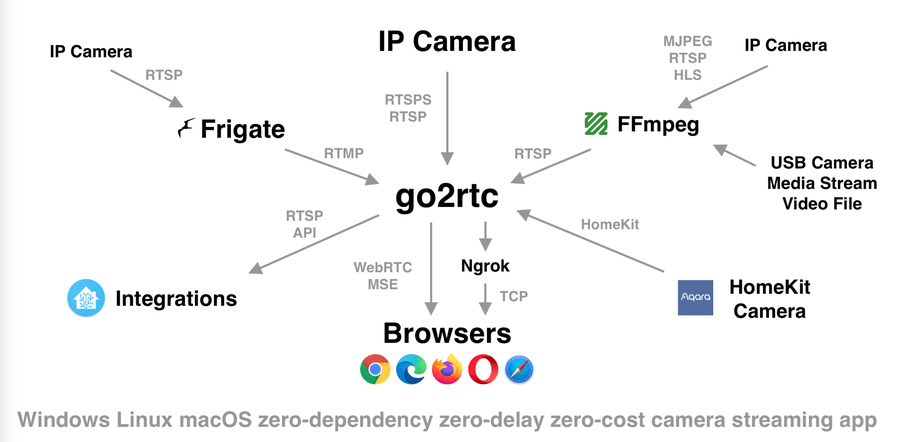
Go2RTC is a real-time streaming application designed to connect different media sources and clients. It is particularly prominent in camera and surveillance-oriented environments, where a source such as an RTSP camera may need to be exposed through another protocol such as WebRTC or RTMP.
Its supported ecosystem includes RTSP, RTMP, WebRTC, WebTorrent, MJPEG, MPEG-TS, FLV, and other formats and protocols.
Go2RTC also provides a web interface and configuration system. Its standard API operates on port 1984, while the default RTSP and WebRTC services use ports 8554 and 8555, respectively.
Go2RTC Strengths
- Broad protocol compatibility.
- Particularly suitable for IP cameras and real-time video.
- Can expose one source through multiple streaming protocols.
- Supports streaming ingest from external applications.
- Includes API, WebSocket, debugging, and other supporting modules.
- Available for several operating systems and architectures.
- Docker images support multiple architectures, including amd64, ARM variants, and ARM64.
Go2RTC Limitations
- Its configuration-oriented architecture can require more technical knowledge than a conventional media-player application.
- It is primarily a streaming gateway rather than a torrent-focused media library.
- More protocol flexibility can mean more configuration decisions.
- Some advanced media-processing scenarios may require FFmpeg or other external components.
- Performance depends heavily on the source protocol, codecs, network, and whether streams can be passed through without processing.
Performance Comparison
Performance is difficult to compare as a single number because TorrServe and Go2RTC solve different problems.
TorrServe Performance
TorrServe/TorrServer performance is influenced heavily by torrent availability and download conditions. TorrServer uses caching to buffer torrent data before serving it through HTTP, making cache configuration and available network bandwidth important factors.
For compatible torrent-based video, this approach can avoid waiting for a complete download. However, a poorly seeded torrent or unstable peer connectivity can cause playback interruptions regardless of the capabilities of the playback device.
Go2RTC Performance
Go2RTC is optimized around efficient real-time media transport and protocol conversion. When a stream can be passed through without transcoding, the processing requirements can be relatively low because the server does not need to decode and re-encode every video frame.
Its architecture supports multiple source and output protocols, including RTSP, WebRTC, RTMP, and WebTorrent.
For camera systems, network latency, codec compatibility, and the selected output protocol are therefore often more important performance factors than raw CPU power alone.
Compatibility and Platform Support
TorrServe
TorrServe is primarily an Android client, while TorrServer provides the server component. TorrServer has platform-specific binaries and can also be built for systems such as Linux and macOS.
The Android application includes support for Android TV/Leanback-related functionality, although actual device compatibility depends on the Android environment and release.
Go2RTC
Go2RTC is designed as a cross-platform server application. Official releases include builds for platforms such as Linux, Windows, macOS, and FreeBSD across multiple CPU architectures. Docker images are also available for several architectures.
This makes Go2RTC particularly adaptable for home servers, NAS environments, containers, small computers, and camera-management systems.
Requirements
The basic requirements differ significantly.
TorrServe/TorrServer:
- Android device for the TorrServe client.
- TorrServer instance for torrent processing.
- Network connectivity.
- Sufficient RAM/cache resources for the intended workload.
- Additional GStreamer components for supported transcoding/remuxing builds. TorrServer’s current documentation specifies GStreamer 1.22 or newer for those builds.
Go2RTC:
- A supported operating system or container environment.
- Appropriate network access to the source streams.
- Configuration file or WebUI configuration.
- Additional media-processing tools only when a particular workflow requires them.
- Compatible camera/source protocols and codecs.
Go2RTC’s default configuration uses YAML, with the WebUI available through its API service.
Use Cases
TorrServe is suited to scenarios such as:
- Torrent-based movie and TV playback.
- Streaming torrent content to compatible HTTP players.
- Android TV-oriented torrent playback.
- Local media setups where torrent caching is desirable.
- Integrations that use TorrServer’s API or Torznab ecosystem.
Go2RTC is suited to scenarios such as:
- IP camera streaming.
- Home surveillance systems.
- Converting RTSP camera feeds to WebRTC.
- Providing multiple outputs from a single media source.
- Connecting media sources to applications that require different protocols.
- Integrating real-time video into home-automation or browser-based environments.
Go2RTC’s module architecture is explicitly designed around media formats, protocols, inputs, outputs, and streaming communication, which reflects its role as a media gateway rather than a conventional torrent player.
Configuration and Ease of Use
TorrServe tends to be more directly aligned with users whose main objective is torrent-based media playback. The Android client provides a user-facing layer, while TorrServer supplies the server functionality.
Go2RTC takes a more infrastructure-oriented approach. Its YAML configuration defines streams and sources, while the WebUI provides configuration editing and validation.
As a result, the two applications have different learning curves: TorrServe emphasizes media consumption, whereas Go2RTC emphasizes media routing and integration.
Pros and Limitations Summary
TorrServe
Pros
- Torrent streaming is its central purpose.
- HTTP-based playback is broadly useful with compatible clients.
- Torrent caching reduces the need to wait for complete downloads.
- Android-focused client experience.
- TorrServer supports APIs, remote servers, Torznab, DLNA, and optional media processing.
Limitations
- Less focused on live camera and real-time protocol conversion.
- Server/client architecture can require separate setup.
- Advanced transcoding can require additional GStreamer components.
- Playback depends substantially on torrent availability and network conditions.
Go2RTC
Pros
- Broad real-time streaming protocol support.
- Strong fit for IP-camera and surveillance workflows.
- WebRTC, RTSP, RTMP, and other streaming outputs.
- Cross-platform and multi-architecture availability.
- API and modular architecture for integrations.
Limitations
- More infrastructure-oriented configuration.
- Not primarily designed as a torrent-media application.
- Complex workflows can require knowledge of codecs and streaming protocols.
- Some processing scenarios can require additional media tools.
TorrServe vs Go2RTC: Key Differences
The central distinction is what each project treats as the streaming problem.
TorrServe/TorrServer is centered on torrent content delivery: torrent data is cached and exposed for HTTP-based playback.
Go2RTC is centered on real-time media interoperability: it connects sources and clients using a variety of streaming formats and protocols, with particular relevance to cameras and live video.
Consequently, comparing them purely by CPU usage, number of protocols, or supported platforms can be misleading. Their feature sets overlap in some areas, but their primary roles are different.
Conclusion
TorrServe and Go2RTC occupy different positions within the streaming ecosystem. TorrServe/TorrServer is primarily a torrent-streaming solution with caching and HTTP delivery, while Go2RTC is a cross-platform real-time media gateway focused on connecting sources and clients across multiple streaming protocols.
For an evaluation based on torrent playback, torrent caching, and Android-oriented consumption, TorrServe’s feature set is centered on those requirements. For camera feeds, real-time streaming, protocol interoperability, and multi-platform media infrastructure, Go2RTC provides a different set of capabilities.