SkyTube and Go2RTC are both software projects associated with video streaming, but they serve very different purposes. SkyTube is primarily an Android application focused on accessing YouTube content without relying on the official YouTube app, while Go2RTC is a lightweight media streaming server designed to ingest, process, and redistribute real-time video streams.
Because their goals and architectures differ, comparing them is most useful when looking at their intended environments, supported protocols, performance characteristics, setup requirements, and practical use cases.
SkyTube vs Go2RTC Overview
| Category | SkyTube | Go2RTC |
| Primary purpose | Alternative YouTube client | Real-time media streaming server |
| Main platform | Android | Windows, Linux, macOS, and other supported environments |
| Project type | Mobile application | Streaming infrastructure/server |
| Main focus | YouTube browsing and playback | Video/audio stream ingestion and delivery |
| Typical users | Android users | Developers, server administrators, and streaming users |
| Real-time streaming | Limited to its video playback role | Core functionality |
| Protocol support | Primarily designed around YouTube access | Supports multiple streaming protocols |
| Hardware requirements | Android phone or tablet | Computer, server, NAS, or compatible device |
| Setup complexity | Generally straightforward | Depends on the streaming architecture |
| Automation | Limited | Extensive integration possibilities |
| Self-hosting | Not its primary role | Major use case |
| Best suited for | Personal YouTube consumption | Cameras, media servers, and stream redistribution |
What Is SkyTube?
SkyTube is an open-source Android application designed as an alternative interface for watching YouTube content. Rather than functioning as a general-purpose streaming server, it provides a mobile-oriented environment for discovering and playing online videos.
Its feature set is centered around viewing content, managing subscriptions, and interacting with YouTube through an alternative client architecture.
Key SkyTube Features
- Android-focused video playback
- Open-source application design
- YouTube content browsing
- Subscription management
- Video search and discovery
- Alternative approach to the official YouTube application
- Mobile-friendly interface
- Features designed around personal video consumption
SkyTube is therefore primarily an end-user application, rather than a component intended to distribute streams to other clients.
What Is Go2RTC?
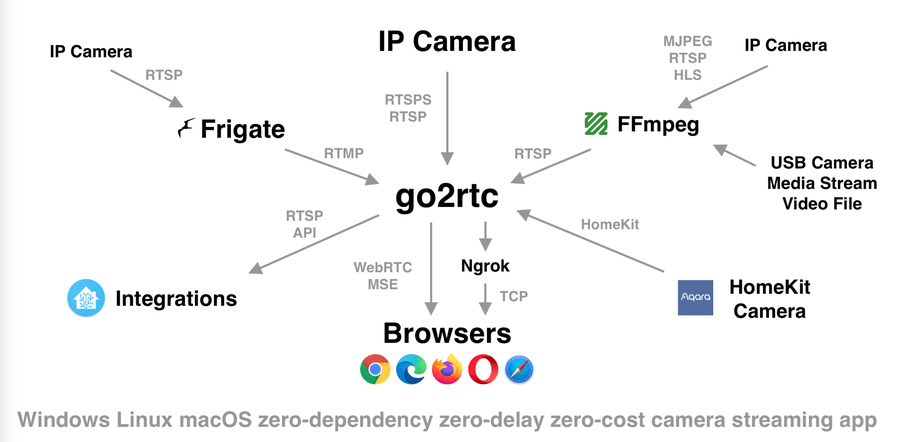
Go2RTC is a media streaming server written in Go. It is designed to work with real-time audio and video sources and can act as an intermediary between media sources and viewing applications.
It is particularly relevant to projects involving IP cameras, surveillance systems, home automation, WebRTC, and other real-time video applications.
Key Go2RTC Features
- Real-time audio and video streaming
- Multiple streaming protocol integrations
- WebRTC support
- RTSP support
- Stream conversion and forwarding capabilities
- Integration with cameras and media applications
- Lightweight server architecture
- Configuration-based operation
- Suitable for self-hosted environments
Unlike SkyTube, Go2RTC is infrastructure software. It can sit between a camera or other media source and the application consuming the stream.
Features and Functionality
The biggest difference between SkyTube and Go2RTC is the level at which each operates.
SkyTube provides an interface for people who want to browse and watch online video content. Its functionality is therefore centered on discovery, playback, subscriptions, and Android usability.
Go2RTC focuses on the underlying media stream. It can receive streams from supported sources and make them available through appropriate protocols or endpoints.
SkyTube
- Designed for individual video consumption
- Optimized for Android devices
- Focuses on YouTube-related functionality
- Provides a graphical user interface
- Does not function as a general-purpose streaming relay
Go2RTC
- Designed for stream processing and distribution
- Works with real-time media sources
- Provides server-side functionality
- Can integrate with cameras and other streaming systems
- Supports several protocols and delivery mechanisms
Performance Comparison
Performance depends heavily on what each application is being asked to do.
SkyTube’s performance is influenced by the Android device, network connection, video resolution, and the way online video is retrieved and decoded. Modern Android hardware can generally handle common video playback workloads efficiently.
Go2RTC’s performance is influenced by the number of streams, codecs, resolutions, network throughput, protocol conversions, and whether the system needs to perform additional processing.
Because Go2RTC is designed for real-time streaming infrastructure, resource consumption can vary substantially depending on the server configuration and workload.
Performance Factors
SkyTube
- Android CPU and GPU capabilities
- Available memory
- Network bandwidth
- Video resolution
- Video decoding support
- Device temperature and battery limitations
Go2RTC
- CPU resources
- Number of simultaneous streams
- Video codec
- Audio codec
- Stream resolution and bitrate
- Network bandwidth
- Protocol conversions
- Server hardware
Consequently, raw performance figures between the two are not directly comparable because they perform fundamentally different tasks.
Compatibility
Compatibility is another area where SkyTube and Go2RTC have distinct objectives.
SkyTube is primarily intended for Android. Its compatibility therefore revolves around Android hardware, operating-system versions, and access to supported online video services.
Go2RTC is designed for server and embedded environments. It can be used on operating systems and hardware capable of running its binaries or supported deployment methods.
SkyTube Compatibility
- Android smartphones
- Android tablets
- Compatible Android environments
- Devices capable of handling supported video formats
Go2RTC Compatibility
- Linux systems
- Windows systems
- macOS environments
- NAS and server hardware
- Home-server installations
- Systems connected to IP cameras
- Applications supporting its available streaming interfaces
Requirements
SkyTube Requirements
SkyTube generally requires:
- A compatible Android device
- Sufficient storage for the application and cached data
- Internet connectivity for online content
- Hardware capable of decoding the desired video quality
Its installation and day-to-day operation are comparatively straightforward because users primarily interact with it as a mobile application.
Go2RTC Requirements
Go2RTC typically requires:
- A supported operating environment
- Appropriate network connectivity
- A source such as a camera or media stream
- Configuration appropriate to the desired protocols
- Sufficient CPU, memory, and network capacity
For simple streaming setups, hardware requirements can be modest. Larger installations with multiple high-resolution streams can require substantially more resources.
Use Cases
The intended use cases make the distinction between the projects especially clear.
SkyTube Use Cases
SkyTube can be used for:
- Watching YouTube videos on Android
- Browsing video content
- Managing YouTube subscriptions
- Alternative YouTube-client workflows
- Personal mobile video consumption
Go2RTC Use Cases
Go2RTC is more appropriate for technical streaming scenarios such as:
- IP camera streaming
- Home surveillance systems
- WebRTC-based applications
- Media stream redistribution
- Home automation integrations
- Self-hosted video infrastructure
- Connecting cameras with different streaming clients
Pros and Limitations
SkyTube Pros
- Designed specifically for Android users
- Focused interface for video consumption
- Open-source project
- Provides an alternative way to access YouTube content
- Generally easier for individual users to understand and operate
SkyTube Limitations
- Primarily tied to the Android ecosystem
- Focused on YouTube rather than general media infrastructure
- Not designed to operate as a streaming server
- Dependent on compatibility with changes affecting YouTube access
- Not intended for multi-client real-time stream distribution
Go2RTC Pros
- Designed specifically for real-time media streaming
- Supports multiple streaming technologies
- Useful for IP-camera environments
- Can serve as a bridge between different streaming systems
- Suitable for self-hosted deployments
- Can integrate with broader home-server and automation setups
Go2RTC Limitations
- Requires more technical configuration than a typical mobile application
- Performance depends on the number and type of streams
- Server administration knowledge may be necessary
- Configuration can become more complicated in larger deployments
- Not intended as a general-purpose YouTube viewing application
SkyTube vs Go2RTC: Which Environment Fits Each?
The two projects address different layers of the video ecosystem.
SkyTube is an end-user application. Its purpose is to provide an Android-based environment for finding and watching online videos.
Go2RTC is backend infrastructure. Its purpose is to handle real-time media streams and connect sources with compatible clients or services.
A person choosing between them should therefore first identify whether they need a mobile video client or a real-time streaming server. Their overlapping connection to video does not mean they are direct substitutes.
SkyTube vs Go2RTC: Main Differences
- Purpose: SkyTube focuses on video consumption, while Go2RTC focuses on real-time stream handling.
- Platform: SkyTube primarily targets Android; Go2RTC targets server and computing environments.
- Architecture: SkyTube is an application; Go2RTC is streaming infrastructure.
- Streaming: Go2RTC is built around real-time media workflows, whereas SkyTube is primarily a video playback client.
- Configuration: SkyTube generally requires less technical setup, while Go2RTC can require server and protocol configuration.
- Use cases: SkyTube fits personal YouTube viewing, while Go2RTC fits cameras, WebRTC, and self-hosted streaming systems.
- Scalability: Go2RTC can participate in multi-stream deployments, while SkyTube is primarily designed for individual Android usage.
Conclusion
SkyTube and Go2RTC occupy different areas of the video technology landscape. SkyTube is an Android-oriented application focused on browsing and watching YouTube content, while Go2RTC is a lightweight streaming server intended for real-time media workflows.
Their differences in architecture, compatibility, requirements, and use cases mean they should not be viewed as direct replacements for one another. SkyTube centers on the viewer experience, whereas Go2RTC centers on stream handling and distribution. Understanding these roles makes it easier to determine how each fits into a particular video-related setup without treating either project as universally better.