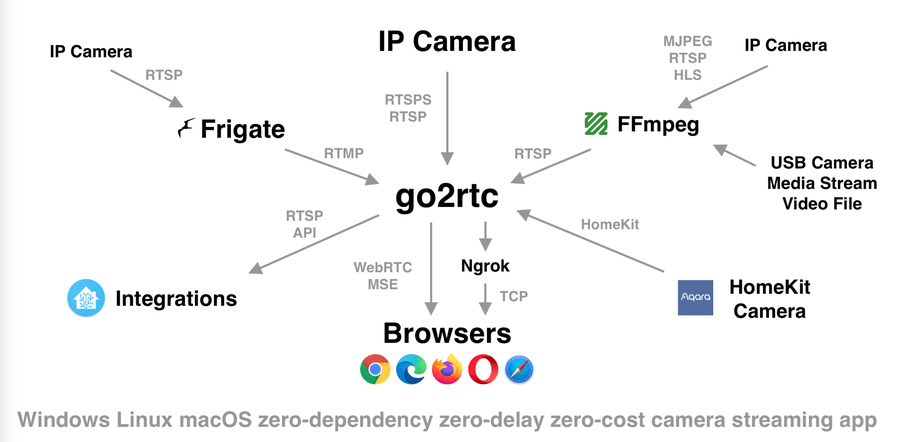
IPTVnator and Go2RTC are both open source projects associated with video streaming, but they serve very different purposes. IPTVnator is primarily an IPTV player designed to organize and play television streams from playlists. Go2RTC is a streaming gateway and media relay focused on receiving, processing, converting, and delivering video streams between different protocols and applications.
Understanding the differences between IPTVnator and Go2RTC is important because they are not direct alternatives in terms of their core design. IPTVnator focuses on the viewing experience, while Go2RTC focuses more on stream connectivity, protocol conversion, and integration with other systems.
IPTVnator vs Go2RTC at a Glance
| Feature | IPTVnator | Go2RTC |
| Primary purpose | IPTV playback | Media streaming gateway |
| Main focus | Watching IPTV channels | Connecting and converting streams |
| IPTV playlist support | Yes | Not primarily a playlist player |
| User interface | Graphical interface | Primarily configuration/API based |
| Stream relay | Limited compared with Go2RTC | Core functionality |
| Protocol handling | Depends on playback engine | Supports multiple streaming protocols |
| EPG support | Available for IPTV workflows | Not designed as a traditional EPG solution |
| Desktop viewing | Yes | Usually requires another client |
| Home automation integration | Limited | Strong integration potential |
| Server use | Possible, but not its main role | Common use case |
| Technical complexity | Relatively straightforward | More technical |
| Typical users | IPTV viewers | Developers, integrators, and media-server users |
IPTVnator Features and Capabilities
IPTVnator is built around IPTV playback. It can work with IPTV playlists and provides a graphical environment for browsing channels and playing available streams. Its interface is intended to make IPTV content easier to organize compared with manually opening individual stream URLs.
The application can support common IPTV playlist formats and related metadata depending on the configured source. Features such as channel organization, electronic program guide information, favorites, and playback controls make IPTVnator more suitable for users who primarily want to interact with IPTV content through a desktop application.
Another important aspect of IPTVnator is that it acts mainly as a client. The application does not exist primarily to function as a media gateway between cameras, servers, and different streaming protocols. Its role is closer to that of an IPTV frontend where users provide legitimate stream sources and then watch them through the application.
IPTVnator Pros
- Dedicated IPTV-oriented interface
- Playlist-based channel organization
- Desktop-focused viewing experience
- Useful for browsing large IPTV channel collections
- Open source and community developed
IPTVnator Limitations
- Not designed primarily as a streaming gateway
- Advanced media-server integration is not its central purpose
- Playback can depend on the stream format and underlying player capabilities
- Its usefulness depends heavily on the quality and compatibility of the IPTV sources being used
Go2RTC Features and Capabilities
Go2RTC takes a different approach. It is designed as a media streaming gateway that can connect different video sources and make streams available through suitable protocols. This makes it particularly relevant to self-hosted media systems, surveillance applications, smart-home platforms, and custom streaming environments.
Rather than concentrating on a graphical channel list, Go2RTC focuses on moving media between systems. It can work with different input and output technologies and can help bridge compatibility gaps between a source and the application that needs to consume it.
Go2RTC is also designed with automation and integration in mind. It can be used as part of a larger architecture in which another application provides the user interface. This makes it fundamentally different from IPTVnator, where the application itself provides the primary viewing interface.
Go2RTC Pros
- Designed for stream processing and relaying
- Supports multiple streaming technologies
- Useful for self-hosted media environments
- Suitable for cameras and other live video sources
- Can integrate with other applications and automation systems
- Better suited to server-side streaming workflows
Go2RTC Limitations
- More technical to configure than a conventional IPTV player
- Not intended to replace a full IPTV viewing interface
- Does not focus on traditional IPTV channel browsing
- Users may need another application for convenient viewing
- Configuration and protocol concepts can require additional technical knowledge
IPTVnator vs Go2RTC Performance
Performance depends heavily on the role each application is performing. IPTVnator generally has a straightforward workload when it is being used to open and play an IPTV stream. The actual playback experience can depend on factors such as stream bitrate, codec, network stability, operating-system resources, and the playback technology being used.
Go2RTC can have a more demanding workload when it is relaying, converting, or processing streams. Its performance therefore depends on the number of simultaneous streams, source formats, output formats, transcoding requirements, network capacity, and available CPU resources. Direct stream forwarding can be considerably different from operations that require media conversion.
These differences mean performance should not be judged solely by which application consumes fewer resources. IPTVnator is generally performing the role of a client, while Go2RTC can function as an intermediary within a larger streaming infrastructure.
Compatibility and Platform Considerations
IPTVnator is intended for desktop environments and is useful where users want a graphical IPTV application. Its compatibility therefore depends on the supported operating systems, available application builds, and the media formats that can be handled by its playback components.
Go2RTC is more oriented toward server and integration environments. It can be deployed in self-hosted systems where a media source needs to be exposed through a protocol supported by another application. This makes operating-system compatibility only one part of the equation because network architecture, codecs, protocols, and connected applications are equally important.
For users comparing the two projects, compatibility should therefore be considered according to the intended task. Someone looking for a desktop IPTV player has different requirements from someone building a camera streaming pipeline or media gateway.
IPTVnator vs Go2RTC Requirements
IPTVnator generally requires a compatible desktop environment, the application itself, and accessible IPTV playlist or stream sources. Hardware requirements are normally influenced by the video streams being played rather than by IPTVnator alone. Higher-resolution or more demanding codecs can require greater system resources.
Go2RTC typically requires a system capable of running the gateway continuously and communicating with the relevant media sources and clients. Depending on the configuration, users may also need to understand networking, ports, stream URLs, codecs, authentication, and protocol-specific settings.
A simple IPTV playback setup can therefore involve fewer technical components than a Go2RTC deployment. On the other hand, Go2RTC can become a useful building block when a streaming system needs more advanced connectivity between different applications and devices.
IPTVnator and Go2RTC Use Cases
IPTVnator is primarily suited to personal IPTV consumption. Users can load compatible playlists, browse available channels, organize content, and play streams through a graphical application. It can be useful when the main objective is viewing rather than building a streaming infrastructure.
Go2RTC is better aligned with technical streaming workflows. It can be incorporated into systems involving network cameras, media servers, home automation, browser-based playback, and other applications that need access to live video through compatible streaming methods.
The distinction is important because the projects may appear related when both are used with video streams, yet their roles are substantially different. IPTVnator is primarily the viewer, whereas Go2RTC can operate as the connectivity layer that helps another application receive or process a stream.
Ease of Use and Configuration
IPTVnator generally provides a more familiar experience for users who want to open an application and manage IPTV channels through a graphical interface. Once compatible sources are configured, everyday tasks such as selecting channels and controlling playback can be relatively straightforward.
Go2RTC requires a more infrastructure-oriented mindset. Configuration is usually based around streams, sources, protocols, and connected clients rather than a traditional television-style interface. This provides greater flexibility for technical deployments but can make the initial setup less intuitive for users who simply want to watch IPTV.
IPTVnator vs Go2RTC: Key Differences
The biggest difference is their intended function. IPTVnator is an IPTV player, while Go2RTC is a streaming gateway. IPTVnator puts the viewer and channel interface at the center of the experience. Go2RTC puts stream interoperability and delivery at the center.
They also differ in how they fit into a larger system. IPTVnator can operate as the application a person uses directly, while Go2RTC is often more useful behind another application or service. Consequently, the two projects can sometimes appear in the same broader media ecosystem without actually competing for the same role.
Choosing Between IPTVnator and Go2RTC Based on Use Case
For IPTV viewing, the relevant considerations include playlist support, channel organization, EPG functionality, playback compatibility, and desktop usability. These requirements correspond closely with IPTVnator’s design.
For stream integration, protocol conversion, camera feeds, media-server connectivity, and automated streaming infrastructure, the important factors are different. Protocol support, relay capabilities, deployment flexibility, and integration options become more significant, which aligns more closely with Go2RTC’s purpose.
Neither project should therefore be evaluated only by counting features. A feature that is valuable in an IPTV player may have little importance in a streaming gateway, and vice versa. The appropriate choice depends on whether the primary requirement is consuming IPTV content or managing the delivery of live media between systems.
Conclusion
IPTVnator and Go2RTC occupy different positions within the streaming ecosystem. IPTVnator is centered on IPTV playback, playlist management, and a graphical viewing experience, while Go2RTC is designed around stream connectivity, relay functionality, protocol handling, and integration with other media applications.
Their differences in architecture, requirements, configuration, and use cases make them suitable for different types of streaming tasks. Understanding whether the primary need is IPTV viewing or technical stream management provides a clearer basis for evaluating the two projects without treating them as direct substitutes.